Quetzal
Appearance
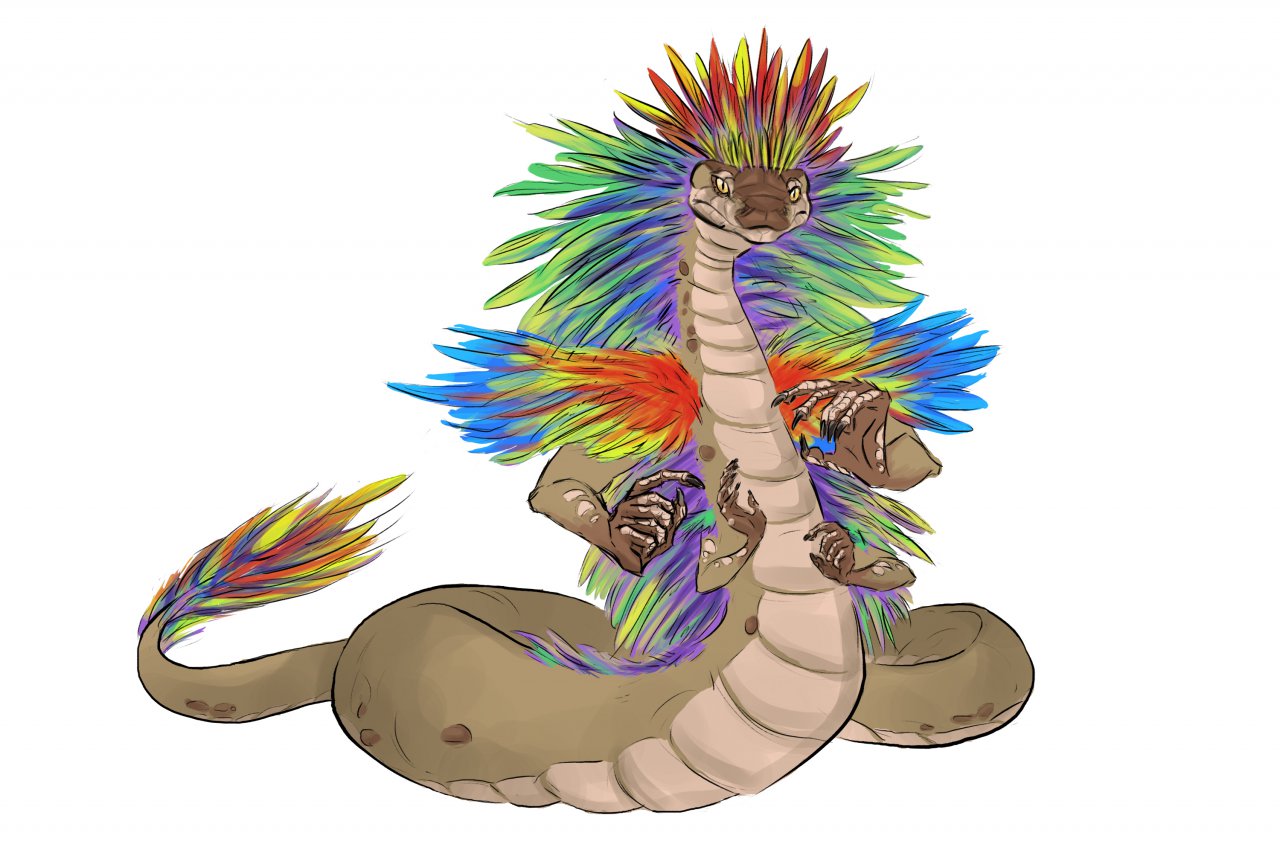 Art by fiddlesketch (commissioned by Warringer)
The Quetzal are serpentine in appearance with a body length of ten to fifteen meters and possess two pairs of arms. Parts of their bodies are covered by multicoloured feathers, especially the upper pair of arms,giving them the appearance of wings, the head and a tuft of bright and especially colourful feathers located at the end of their tails.
Their heads, about one half meter in length, closely resemble cobras with the shield being replaced by a crest of colourful and individually coloured feathers.
The upper pair of arms is located about one to one and a half meters away from the head with the second pair another thirty to fifty centimeters below the first set of arms. The upper pair of arms is about one and a half meters in length ending with long fingered six digit hands. Each digit is topped by a claw, making them useful for hunting and fighting. The lower arms are half the length of the upper arms, ending in finer digits that are perfect for fine manipulation and using tools.
Biology
The Quetzal are distinctly non human life forms and have evolved on a world with three distinct genesis events and 'Trees of Live'. The Quetzal belong to the Quetzal 'Animal kingdom' primarily made up by one of the 'Trees of Live'.
Their average life expectation of the Quetzal is Earth 92 years.
The Quetzal are omnivores, however they prefer a largely carnivorous diet. Next to their stomachs, a liver like organ is the main part of their digestive tract. This organ is essentially a biologic chemical factory able to break down any food they digest and turn it into material their body can make use of. This is because their home world had not only one, but three geneses, leading to three different types of different forms of life with different biologies to co-evolve into a single biome.
Procreation
The Quetzal do not have genders in the sense as humans know it. Rather, they are commonly gender neutral and only develop male or female gender specifics during a special time two years. The selection of the gender for each cycle is random and cannot be manipulated. It is possible to suppress the mating season through herbal and chemical needs, as well as the permanent surgical removal of the dormant sexual organs.
The gender of each Quetzal stabilises within about two weeks, before they fall into a form of mating frenzy. Males and females can mate with up to one hundred different partners within two days. After these two days the males immediately return to the neutral forms, while the females begin to generate up to fifty eggs. These eggs are then laid into prepared containers where they are incubated. In the past the incubation happened in prepared piles of foliage, where the warmth of rotting warmed the eggs.
Only about twenty five eggs hatch after two months, and only up to eight hatchlings survive their first weeks. This is not considered a problem by the Quetzal as any more surviving hatchlings would have lead to overpopulation on their home world.
Life stages
| Life Stage | From (age) | To (age) | Duration (years) |
|---|---|---|---|
| Hatchling | 0 | 3 | 3 |
| Youngling | 3 | 14 | 11 |
| Adult | 14 | 54 | 40 |
| Elder | 54 |
Hatchling
Shortly after hatching, a Quetzal hatchling largely is a creature of instincts, left over from earlier stages of Quetzal evolution. Here, they are largely capable of living independent and can hunt and feed for themselves. A hatchling only slowly develops a consciousness and only after about three years reaches the next stage of life.
It is of note only about ten to twenty percent of all hatchlings survive the hatchling stage. In some cases diseases, parasites or birth defects lead to death. In others accidents are to blame. Additionally, the hatchling is cannibalistic in this life stage and it is possible that one hatchling hunts down and consumes another hatchling.
Physically a hatchling grows to five times its original size, from a length of about 30 centimeters to about 150 centimeters, though the head grows to nearly its full final size.
Adult Quetzal do not form emotional attachments to their hatchlings and they are no negative emotional impacts on the death of one or more hatchlings.
Youngling
After about three years a Quetzal hatchlings enters the Youngling stage, where they have developed a working consciousness. A Younglings mind slowly develops more or less along the line of a human child, while they grow to the adult size.
Adult
Once a Quetzal takes part in the first mating cycle around the age of 14 years, they enter the Adult stage.
Elder
Any Quetzal can take part in up to 20 mating cycles, before a hormonal change causes their bodies to resorb their sexual organs.
Society/Sociology
While the Quetzals evolutionary ancestors have initially been solitary omnivores with a carnivore bias, they have developed into social animals during their evolution. This resulted into the development of large clan like family structures, called Vorem, that can have up to 2000 members, but have usually about 250 members.
In a traditional Vorem, the Elders are for the most part charged with looking after the Hatchlings and raising the Younglings, while the Adults are responsible for providing for the Vorem by plying various trades. These traditional Vorem usually live in a single building complex equivalent to towns during the Quetzal Stone ages. Trade between these small towns also involved exchanging members of the Vorem itself.
In the Quetzal early Bronze age these small towns grew to contain multiple Vorem and these started to specialise towards one or two trades, like metal working, farming or trading. Since then Merchant Vorem have become among the largest of the Vorem, spread out over multiple building complexes and multiple towns or cities.
The rather high reproduction rate of the Quetzal results in population pressure from overpopulation and diminishing natural resources, forced the development of towns and cities, which in turn lead to the formation of nations, which are traditionally considered larger versions of the traditional Vorem.
Biologically the Quetzal possess what is called 'stepped survival instinct' (SSI), which in turn has effects on their society. In essence this can be simplified as following in order of importance:
- Survival of the Quetzal
- Survival of the Nation
- Survival of the City/Town
- Survival of the Vorem
- Survival of the Individual
Additionally a Quetzal will freely give his life to protect his Vorem, a Vorem will accept destruction to protect its town or city, a city will do its best to protect its nation. In the end result it meant that all nations were willing to accept destruction to protect some fleeing Vorem as it meant the Quetzal would survive.
The SSI, in combination with the traditional Vorem, leads to the Quetzal being a collectivist society. National governments have usually used these traits to reduce population pressure by declaring wars on other nations, partly to decrease numbers of Adult and Elder Quetzal, which in turn reduced numbers of Hatchlings and Younglings, as well as taking over new resources and fertile lands.
Also due to the SSI, there are no effective civilians among the Quetzal and the entire population of a town, down to Younglings, will try to fight off any invading force, more often than not resulting in the destruction of the entire population than not.
Technology Level
Quetzal technology (used by the Quetzal discovered in Sol) is more advanced than Earth technology (2150) by at least fifty years. While they do possess an advanced FTL drive, most other technologies are simply more advanced versions of already existing technologies.
From what is known of their ships, they are/used to be generally of utilitarian shape with only a minimum of differences between the designs, depending on their construction.
Unique Technologies
Due to the population pressure, the Quetzal have begun to develop technologies to establish ocean going towns and cities during the early Iron Age and refined them since then. This lead to the establishment of purely ocean going nations living off fishing, deep sea resource extraction and trade.
Government
Over the course of Quetzal history, the Quetzal have developed almost the same governmental structures developed by humanity, though their more collectivist nature as well as their survival drive lead to a socialist bias in Quetzal politics.
Religion
Quetzal religion is largely a result of the Quetzal biology and the existence of a soul is taken as a given. The high mortality rate of Hatchlings and the high percentage of infertile eggs lead to developing the more or less general believe the number of souls is limited. While souls are limited in number, new souls do get born, but need to 'mature' by being born again and again, with the 'immature soul' being unable to keep the body alive. Only when a Quetzal survives to become an 8 year old Youngling, the soul is considered fully 'mature'. This in turn means that reincarnation is accepted as being normal.
For the most part Quetzal religions are polytheistic in nature with only two monotheistic religions. Another single religion does has no deities at all.
Quetzal on Earth
At least three Quetzal have been confirmed to have been on Earth around 1000 BC.
The first one, named Ranyr of Sertin (actually a military rank like NATO OF-1), crashed down near the Mexican coast in a lifeboat and survived for at least thirty years, being worshipped as a god by the Olmec in the area.
The second one, Mostur of Awenda, but also known as the Imperial Dragon, crashed down in China and was then taken as the Qin as a prisoner, before managing to become the adviser of the Qin Emperor. He lived for at least twenty years. From his dictionaries, taken in Qin Chinese, he used to be a deckhand on his ship, responsible for maintaining shuttle craft and lifeboats.
A third Quetzal has landed in Germany, where he his is spacecraft in a cave in the Drachenfels, near Bad Honnef. He was eventually killed by a human in the area, which somehow collapsed the cave. The scene is repeatedly compared to the 'Niebelungenlied'.
It is possible that other Quetzal have survived the destruction of their ship near Earth and made it to our planet in their lifeboats. The Japanese Naga myth could be related to the Quetzal.
Cultural Groups
There are five known major cultural groups in the Iwrin system, which between themselves make up about 95% of the 24.2 billion strong population.
United Sects
The United are the oldest culture of Iwrin and have a continuity from before the destruction of Cretin by The Plague.
The Culture is based around a monotheistic faith and was formed by the head of the faith at the time fleeing to the stations at the Seuwak gas giant and taking them over at the time of The Plague.
Starting out as an oppressive theocratic regime, over time it transformed into a closed culture with limited contact with the other cultures at Iwrin. They have lost most of their oppressiveness, in exchange of trying to provide as much comfort and meaning for it's members.
Dram
Sysh
Petanai
The Petanai are a culture that developed around the dead home world of the Quetzal, Cterin, following The Plague.
Started on an almost completed Islan Type 3 like orbital settlement, it was made up of Quetzal that either could not or would not leave their home world behind, not caring about their own death, but caring of defending their dead home world.
This developed into a culture that, while not revering death is conscious of death, and have gone into a form of ancestor worship and seeing death as a basic part of life. In many cases they themselves have noted that they worship life through their acceptance of death and their reverance for it.
As such, they are highly respectful towards the dead and the family of the dead, so that many of the other cultures consider them highly in roles that are connected to death.
They have generically altered themselves into albinos, with red eyes and while colourless plumage, following the image of the avatar used by the synthetic intellect Petan.
Another thing is that they have a class of uploaded intellects, called Guardians, who have been uploaded into a digital form upon their death. Guardians make up the majority of the Petanai military forces, as they consider themselves as 'the dead in service to protect the living' and are highly respected in Petanai culture.
Loners
The Loners are less of a single homogeneous culture as a myriad of cultures that have developed independently along very similar lines within the Kuiper Belt of Iwrin.
Formed from survivors that went as far away from the inner system as possible on the wake of The Plague, they are a set of largely isolationist cultures and societies that want little to do with the inner system, but feel that they need to interact with them to make sure that they are heard.
Languages
While historically, the Quetzal had a larger number of languages, the destruction of Cterin and the subsequent Survival Period saw the spoken and written languages of the Quetzal reduced to a single language, Setalai, which had been used by the Quetzal as a trade language for centuries.
From Setalai, the modern Quetzal languages developed, with the Petanai language retaining the closest relation to Setalai, though even native Setalai speakers (of the survivors found in the Siol system) have problems understanding Petanen, the modern Ligua Franca of the Iwrin system.
There are several loan worlds of Petanen that have made their way into human languages, foremost their name for Heim-Feynman space, Deych Adema Ispim or The Everchanging Black.
The Petanen suffix '-ai', meaning 'People/Person of' was adopted by several groups within the Sol system, first and foremost my the Titanian heptapods and their AI partners, to create the word Titanai for their people/culture. Sometimes, younger groups of Spacers call themselves Deychai, People of the Black, something that seems to catching on in the larger spacer culture.
Neocoatl
Neocoatl is the self selected term used by Quetzal hatched and grown up in a homo sapiens cultural context, coined by best generation Earth born Quetzal.
The term came about as a consequence of the inability of their parents, all survivors of the Last War, to connect and actually raise their offspring, due to various psychological problems, combined with the urge to repopulate the species', leading to the hatching of too many young Quetzal and overwhelming any ability to actually raise those offspring. As a consequence, homo sapiens had to step in to help raising the younglings.
This introduced a nearly complete cultural disconnect between the survivor generation and their offspring, who began to describe themselves as 'finny shaped homo sapiens with dietary differences', as they have an easier time connecting to other Earth humans.
The term Neocoatl came about online as a somewhat ironic name for themselves, replacing the 'Quetzal' part of 'Quetzalcoatl', to show that they are more or less new to all of this.
Over the decades the use of the term spread into daily life and eventually academic discourse and is now the general term for this group of Quetzal.